LIFE @Urban Roofs Rotterdam
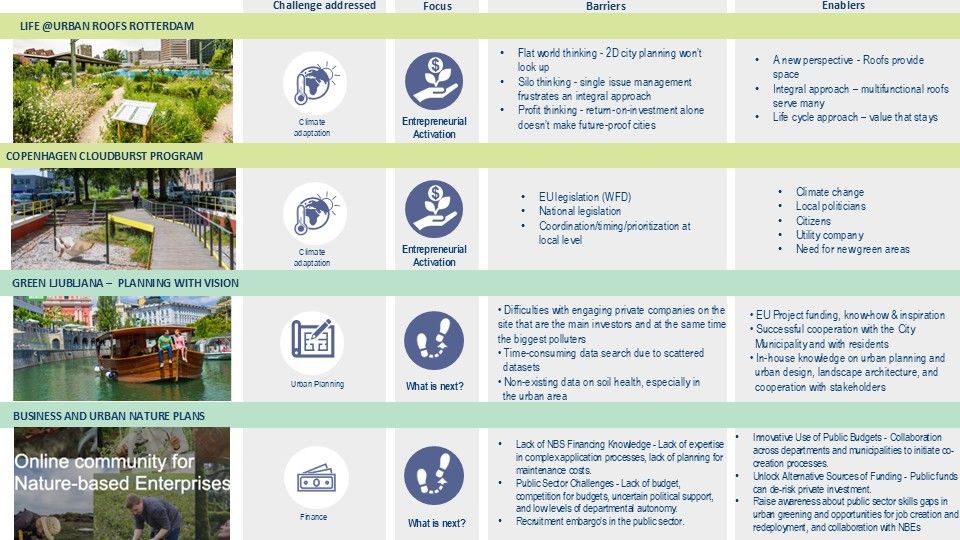
Paul van Roosmalen, Program Manager at the Municipality of Rotterdam, detailed the city's strategy to utilise its 18 million square meters of unused flat rooftops to address pressing urban challenges, including a lack of housing, greening needs, and climate change adaptation. Rotterdam champions multifunctional roofs, combining elements like Green (biodiversity), Blue (water retention), Yellow (solar energy), and Red (social functions).
To address the challenge that NbS often do not generate immediate profit, Rotterdam developed a societal cost-benefit analysis to assign monetary value to the benefits provided by nature (e.g., a square meter of green space or a cubic meter of water retention). This approach allows city officials to demonstrate value and successfully renegotiate who should invest in a project, as benefits often accrue to parties other than the rooftop owner. Motivations for private investors varied, with some major private developers being persuaded by the public relations value of being known as a "green investor".
Copenhagen’s Cloudburst Strategy
Jan Rasmussen, Head of Climate Adaptation in Copenhagen, presented the city’s Cloudburst Program, launched in 2015 to climate-proof the city against severe rain events. The €1.5 billion plan relies heavily on permeable surface solutions (NbS) rather than solely underground pipes, as surface solutions are cheaper and provide co-benefits like increased greenery, biodiversity, and new meeting places.
Citizen engagement is foundational; a large involvement process starts early in development. A key factor enabling this buy-in is that local citizens have directly suffered from past flooding disasters, making them highly motivated to support the plan and the associated increase in water fees necessary to fund the expensive program. Maintenance costs for public areas are split between the city and the utility company, recognising the company’s responsibility for the projects' hydraulic function.
Green Ljubljana–Planning with Vision
Liljana Jankovič Grobelšek provided insight into Ljubljana’s successful path, rooted in a vision developed almost two decades ago, which led to the city being named the European Green Capital in 2016 and receiving the official EU Mission Label in 2024.
Ljubljana’s success is partly attributed to the fact that the mayor has maintained his position since 2006, ensuring the vision remains uninterrupted across political cycles. The city's planning efforts resulted in a robust green character, with three-quarters of the municipality designated as green areas. Financing relies on the mayor’s ability to establish successful partnerships with private and implement small budget initiatives that successfully engage citizens in neighbourhoods and schools. An example includes a long-standing partnership with a commercial zone, which was required to build a private park open to the public.
Finally, Kassia Rudd of ICLEI and Hadiza Lemo of Horizon Nua focused on Unlocking Finance for Urban Nature Plans, introducing the Urban Nature Plans Plus (UNP+) project, which supports cities in developing integrated planning frameworks to align Nature-based Solutions with broader city development goals. Horizon Nua is assisting cities, including Barcelona, Paris, and Belgrade, with the critical step of financing, entrepreneurship, and job creation.
They highlighted prevalent financial barriers, such as a reliance on public budgets facing deep cuts, the challenge of inconsistent political support, and difficulty navigating complex application processes due to limited financial expertise within planning departments. To mitigate these issues, UNP+ promotes:
- Cross-Departmental Budgeting: Combining budgets across departments (e.g., parks, health, education) to fund NbS based on their multiple benefits.
- Blending Funds: Using public money to cover early-stage costs, thereby attracting private investors to scale and sustain the NbS.
- Public-Private-People Partnerships (4Ps): Actively involving citizens and local communities in the maintenance of projects to reduce long-term operational costs and foster ownership.